The Hagia Sophia: Where Christianity and Islam Coexist — and Clash

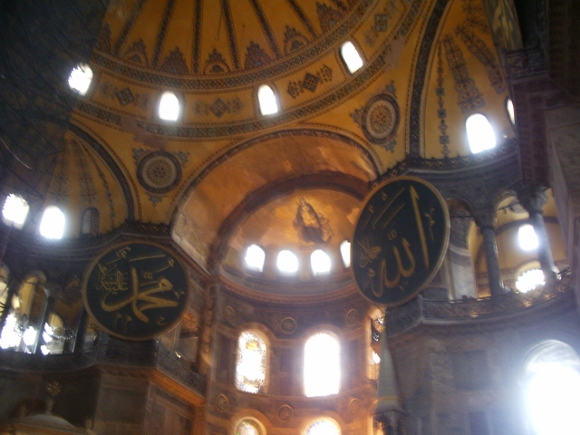
The Hagia Sophia -- Madonna with roundels, Muhammad & Allah. Photo by BF Newhall

In the Hagia Sophia, Christianity's Madonna and Child are flanked by roundels with Arabic script bearing the names of Muhammad and Allah. The rondels were added to the basilica when it became a mosque after the Turks conquered Constantinople in 1453. All photos by BF Newhall 2009

By Barbara Falconer Newhall

As a religion writer, I’ve got plenty of respect for Islam as well as for the many (friendly, smart, lovable, cool, inspiring) Muslims I’ve met on the religion beat over the years. So, trust me. This is not a rant against Islam or Muslims.

It’s about how it feels to have one’s culture and faith obliterated by someone else’s culture and faith. [Read more...]

EmailFacebookTwitterStumbleUponPrintFriendlyShare

GodsBigBlog: Take a Virtual Tour of the Sistine Chapel

In the mood for something beautiful? Take a virtual tour of the Vatican’s Sistine Chapel, complete with musical accompanyment.

Hint: Click and move your mouse around the image, then click on the plus or minus signs to get close-ups of the various paintings.

Enjoy!

EmailFacebookTwitterStumbleUponPrintFriendlyShare

Books Openers: Harvey Cox — You Don’t Have to Believe to Be a Christian

By Barbara Falconer Newhall

I’d like to recommend Harvey Cox’s newest book to all my non-believer friends.

Members of the Religion Newswriters Association were treated to a visit from Harvey Cox at their September conference in Minneapolis. Photo c 2009 B.F. Newhall

Members of the Religion Newswriters Association were treated to a visit from Harvey Cox at their September conference in Minneapolis. Photo 2009 B.F. Newhall

So many of the sophisticated, highly educated people I know labor under the assumption that they have to believe – to assent intellectually to – the factuality of traditional Christian teaching.

It seems that the one thing they have retained from whatever Sunday schooling they had as children is that they must believe every word of the Apostles’ Creed or Nicene Creed.

They don’t. That’s my opinion. And here’s why: The idea of a fixed creed to which a true Christian must subscribe dates back, not to the life of Jesus, but to the fourth century, when the emperor Constantine converted to Christianity and took control of the church.

Constantine saw great possibilities in the popular new religion that was spreading like wildfire across his empire. But beliefs about the nature of Jesus Christ were diverse and often contradictory in that early church. A common religion with a common creed, Constantine reasoned, would help him to unify — and control – the many and varied peoples of the Roman Empire. With that in mind, he insisted that church leaders come together and settle on a single set of beliefs.

The bishops complied, and in the centuries that followed – right up into the twentieth century – Christians were taught that, to be a true Christian, one had to believe.

So powerful was the Christian belief in belief, that in some eras, heresy – incorrect belief – could get you burned at the stake.

But now, according to Harvard professor and theologian Cox, the age-old Christian belief in belief is becoming a thing of the past: the Age of Belief is over.

Harvey Cox’s ground-breaking The Secular City was a best-seller in 1965. It sold more than 1 million copies. Now, with his newest book, The Future of Faith, the Harvard theologian presents fresh food for thought: that Christianity is entering a new era. He calls it the Age of the Spirit.

Cox identifies three ages in Christian history:

The Age of Faith. In the first three centuries of Christian history, Cox argues, the early church was not concerned about creed, doctrine, belief or hierarchy. Theological ideas about the nature of God were not as important as following the teachings of Jesus.

The Age of Belief. In the fourth century, Constantine asserted control over the Christian church and insisted that everyone in the empire subscribe to a common creed. As a result, until well into the twentieth century, the church focused on correct belief, on doctrine and orthodoxy. For centuries, Westerners assumed that belief – accepting traditional Christian doctrine – was essential to faith.

The Age of the Spirit. Since the mid-twentieth century, more and more Christians have been ignoring dogma and creed and turning toward a more spiritual Christianity – while finding commonalities with other wisdom traditions. Faith and belief are two different things, Cox argues. Beliefs are opinions, while faith – fidelity – is a way of life, a placing of one’s confidence in Spirit.

harvey-cox-future-of-faith-harperoneUntil recently, Cox was the Hollis Professor of Divinity at Harvard, where he has been teaching since 1965. He retired in September, but he is staying on at Harvard as research professor and is turning his attention to religion and science, and Christian-Muslim relations.

As for my non-believer friends — I hope they’ll open Cox’s book and free themselves of the burden of belief.

The Future of Faith, by Harvey Cox, HarperOne, 245 pages hardcover, $24.99.

EmailFacebookTwitterStumbleUponPrintFriendlyShare

Book Openers: Simone Weil on Prayer — First, Pay Attention

By Barbara Falconer Newhall

Simone Weil’s Waiting for God was first published, posthumously, in 1951. And readers beware: Waiting for God is a dense, highly politicized book. (Weil had been a Marxist and trade unionist before encountering mysticism.) But her startling insights into the nature of God and God’s relationship to humanity remain fresh and are truly worth the struggle through this imposing text.

Weil’s life was a short one. Born in Paris in 1909 to an agnostic, middle class Jewish family, she became a Christian but refused baptism for complex reasons explained in detail in Waiting for God. She died at the age of thirty-four of physical and mental exhaustion, after allowing herself only a meager diet in solidarity with society’s poor and the soldiers suffering on the battlefields of World War II. I’m inclined to conclude that Weil was an anorexic ahead of her time, but that doesn’t mean she isn’t also the modern-day saint and mystic that many believe her to be.

Listen to Simone Weil for yourselves in these selections from Waiting for God:

On page 59: “Prayer consists of attention . . . Students must therefore work without any wish to gain good marks, to pass examinations, to win school successes; without any reference to their natural abilities and tastes; applying themselves equally to all their tasks, with the idea that each one will help form in them the habit of that attention which is the substance of prayer.”

On page 124: “Sin is not a distance, it is a turning of our gaze in the wrong direction.”

On page 126: “God produces himself and knows himself perfectly . . . But before all things, God is love. This love, this friendship of God is the Trinity . . . The love between God and God . . . in itself is God.”

On page 127: “For those who love, separation, although painful, is a good, because it is love. Even the distress of the abandoned Christ is a good. There cannot be a greater good for us on earth than to share in it. God can never be perfectly present to us here below on account of our flesh . . . The universe where we are living, and of which we form a tiny particle, is the distance put by Love between God and God. We are a point in this distance . . . ”

Hmmmm. Amazing stuff, don’t you think?

EmailFacebookTwitterStumbleUponPrintFriendlyShare
<?php if ( function_exists( 'yoast_analytics' ) ) { yoast_analytics(); } ?>