The Writing Room: My Idea of a Good Time — A Week in the Mountains with a Bunch of Other Writers

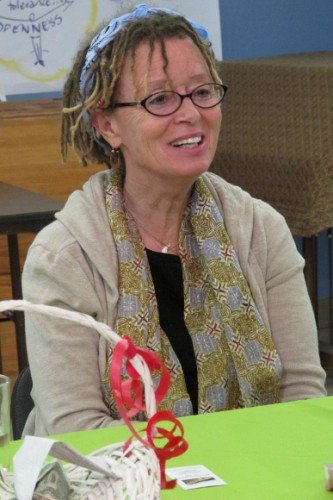
Sharon Olds gives a craft talk at Squaw.

Sharon Olds gives a craft talk at Squaw. Photo by Tracy Hall.

By Barbara Falconer Newhall

Want to meet a poet? Like say, Kazim Ali, Forrest Gander, Brenda Hillman, Evie Shockley or Dean Young?

Or maybe your more into prose, and you’d like to get a close-up look at people like Mark Childress (Crazy in Alabama), Glen David Gould (Carter Beats the Devil), Sands Hall (Catching Heaven), Teresa Jordan (Riding the White Horse Home), ZZ Packer (Drinking Coffee Elsewhere) Luis Albert Urrea (The Hummingbird’s Daughter), Diane Johnson (Le Divorce), Alice Sebold (The Lovely Bones), Amy Tan (The Joy Luck Club), and former California Poet Laureate Al Young.

Then think about applying to attend one of the conferences held every summer in the Sierra mountains by the Community of Writers at Squaw Valley.

I’ve attended the Squaw writers workshops three different summers and loved every moment. Mornings are devoted to workshops, afternoons and evenings to readings and very useful panels on craft, choosing an agent, publishing in literary magazines, and the like.

Squaw is a great place to work on your writing skills, pitch your book project to agents and editors and, best of all, talk writing all the day long with other writers. Two of those three summers I came away with wonderful new friends who formed two different writing groups that have given me terrific feedback on my own projects over the years.

The really good thing about Squaw is how darned friendly everybody is, including the writers and presenters. I can remember a workshop with Alice Sebold’s agent, Henry Dunow; waiting in line for coffee with Anne Lamott; pelting a panel of agents with questions, and watching scenes from “I Walk the Line” with live commentary from the screenwriter Gil Denis.

You have to submit a manuscript and be accepted to attend Squaw. The application deadlines are in the spring.

EmailFacebookTwitterStumbleUponPrintFriendlyShare

The Writing Room: Writer’s Block and the Toxic “Reader”

By Barbara Falconer Newhall

Writer’s block? Not my problem. At least, that’s what I thought until I read Jane Anne Staw’s book, Unstuck: A Supportive and Practical Guide to Working Through Writer’s Block.

unstuck-book-jane-anne-staw-St.-martin'sDuring my many years as a newspaper reporter, it was sit down, write, meet the deadline or find some other line of work. End of story.

So, when I bought Jane Anne Staw’s book a couple years ago, I did so, not because I thought I needed it, but as a favor to Jane Anne. I’ve bought dozens of books by friends and acquaintances over the years on the theory that when I get a book published it will be pay back time. (Right, Jane Anne?)

In other words, I bought, but did not read, Jane Anne’s book.

Then, last December, crashing around the house, looking for something to take with me on our family road trip, I spotted Jane Anne’s unread book, reproaching me from its bookshelf. I grabbed it up, headed for the car and took my assigned place (as the shortest in the family) in the back seat behind Peter (the tallest in the family), who was riding shotgun with the seat pushed back.

Things got boring somewhere along the 10 between West Hollywood and Joshua Tree National Park. So I pulled Unstuck out from under a pile of wet umbrellas and began to read.

To my surprise, writer’s block as Jane Anne describes it, is not always simple primal terror at the sight of a blank page. Writer’s block can be subtle.

It can be the nagging sense that I don’t have the right to write, that my thoughts are not as important as Marilynne Robinson’s , say, or Richard Ford’s.

It can be the belief that successful writers never procrastinate, never blush with embarrassment at what they’ve just written, never rewrite the same sentence eighteen times before throwing up their hands and going into the kitchen to do something useful, like empty the dishwasher.

It can be assuming that someone like Anne Lamott sits calmly at the keyboard while the limpid prose flows from her fingertips – when actually the real Anne Lamott probably rewrites sentences seventeen times, maybe eighteen until she finally gets it right on the nineteenth, and then the next day gets out of bed, has a cup of coffee, and ditches number nineteen for number twelve.

These are good tips from Jane Anne. But the most important lesson I learned between West Hollywood and Joshua Tree, was how important it is be aware of what kind of reader we are writing to. We need to make sure it’s a friendly reader. In my case, not the English department professor at the University of Michigan, but someone nice – one of my sisters-in-law, my college roommate, the friendly woman sitting next to me in the shoe department at Nordstrom.

Somebody who likes and appreciates me – like you, right? (You’ve gotten this far. I’m putting you down for a yes.)

Bottom line, Jane Anne Staw’s book is a godsend for writers who are stuck and know it. It’s also a great read – okay, a godsend – for people like me who need a deeper understanding of themselves as writers. And maybe don’t know it.

How about you? Any tips for curing writer’s block you’d like to share?

Unstuck: A Supportive and Practical Guide to Working Through Writer’s Block, by Jane Anne Staw, Ph.D.,  2003, St. Martin’s Press, $23.95.

Hear about my favorite writing tip at “Ending Paragraphs . . .

EmailFacebookTwitterStumbleUponPrintFriendlyShare
<?php if ( function_exists( 'yoast_analytics' ) ) { yoast_analytics(); } ?>