The Writing Room: Ah, the Colon, That Most Majestic of Punctuation Marks . . .

A Dash of Style

A Dash of Style

By Barbara Falconer Newhall

Wow! A book on punctuation. By Noah Lukeman. The bookstore had an entire book  on punctuation by this master of the dot and the dash. My heart lept.

It was called A Dash of Style: The Art and Mastery of Punctuation. I bought it.

Ever since I read Lukeman’s treatise on the comma — the comma! — in the March/April 2006 issue of  The Writer’s Chronicle, I have been a fan.  A devotee. No, let’s face it, a groupie. This man Lukeman knows  what to do with a comma. Not to mention a period. Or a semicolon. Or my default favorite – the dash.

Take the colon, for example. Maybe you write the colon off as that unassuming pair of dots found on formal business letters, or signalling an upcoming list. And that would be too bad. Because, according to Lukeman, the colon is majestic, dramatic, a writer’s most powerful punctuation tool.

“When it comes to dramatic revelation,” Lukeman writes, “the colon has no second. In this function, the colon acts as a mark point, with the text preceding it building to a revelation, and the text that follows living up to the promise.”

Lukeman suggests comparing this (colonless) sentence:

I grabbed my bag, put on my coat, and stepped out the door, as I wasn’t coming back.

With this one:

I grabbed my bag, put on my coat, and stepped out the door: I wasn’t coming back.

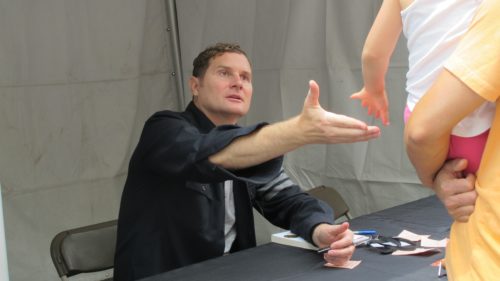
Noah Lukeman

Noah Lukeman

See what I mean?

It’s late. I’m tired. I’m going to bed, and I’m taking Noah Lukeman with me: I want to know what he thinks of the dash.

© 2009 Barbara Falconer Newhall


A Dash of Style: The Art and Mastery of Punctuation, by Noah Lukeman, W.W. Norton, 2006, paper, $13.95.

EmailFacebookTwitterStumbleUponPrintFriendlyShare

Writing Room: Making Friends with the Passive Voice and Its Cousins

Snapdragons in June. c 2009 B.F. Newhall

Snapdragon "Sonnet Mix" flourishing in our yard. These two colors are a little heavy-handed for my taste. c 2009 B.F. Newhall

By Barbara Falconer Newhall

Writing teachers have been warning us against using the passive voice since high school. And rightly so. Passive sentences can be wordy and vague. But they can also come in handy.

What’s a passive sentence? One way to think of it is a sentence that omits or obscures the doer of the action — the agent

For starters, a sentence is passive if it has a passive voice verb:

“The camellias were pruned last month.”

Yawn. Give that sentence a living, breathing subject — a doer — and it comes alive:

“Jillian, our dynamo gardener, pruned the camellias last month.”

Some sentences just feel passive. For example, any sentence that starts out “There is” risks passivity. Compare:

Boring:There are snapdragons thriving in my front yard.”

Snappier: “Snapdragons thrive in my front yard.”

Last year's pansies came up again this spring. c 2009 B.F. Newhall

Last year's pansies came up again this spring. c 2009 B.F. Newhall

Turning a verb into a noun and making it into the subject is another good way to squeeze the life out of a sentence:

Boring:Planting pansies is how I spent the day.”

Engaging:I spent the day planting pansies.”

Still, the passive voice has its uses. Sometimes it helps the reader out by keeping the subject of a sentence short and sweet:

Murky: Surpressing seed germination with a layer of newspaper, then covering it with dirt, horse manure and pea-sized redwood bark solved our weed problem.

Clearer: Our weed problem was solved by putting down a layer of newspaper to supress seed germination, then covering it with dirt, horse manure and pea-sized redwood bark.

Redwood bark keeps the weeds down around this Gerbera Sunburst from Monterey Bay Nursery. c 2009 B.F. Newhall

Redwood bark keeps the weeds down around our "Gerbera Sunburst Coral Pink." c 2009 B.F. Newhall

You can also enlist the passive voice to avoid placing blame:

 ”Dad served our dinner late.”

That’s a perfectly good sentence with nice narrative tension. But if you’re trying to stay on Dad’s good side and don’t mind a little obscurantism, you could say:

“We were served our dinner late.”

President Obama is a master of the well crafted passive sentence. More on him next time.

Meanwhile, pls send along any funny, pithy, lame or obscurantist passive sentences you come across in your reading – or writing!

© 2009 Barbara Falconer Newhall

EmailFacebookTwitterStumbleUponPrintFriendlyShare

The Writing Room: Writer’s Block and the Toxic “Reader”

By Barbara Falconer Newhall

Writer’s block? Not my problem. At least, that’s what I thought until I read Jane Anne Staw’s book, Unstuck: A Supportive and Practical Guide to Working Through Writer’s Block.

unstuck-book-jane-anne-staw-St.-martin'sDuring my many years as a newspaper reporter, it was sit down, write, meet the deadline or find some other line of work. End of story.

So, when I bought Jane Anne Staw’s book a couple years ago, I did so, not because I thought I needed it, but as a favor to Jane Anne. I’ve bought dozens of books by friends and acquaintances over the years on the theory that when I get a book published it will be pay back time. (Right, Jane Anne?)

In other words, I bought, but did not read, Jane Anne’s book.

Then, last December, crashing around the house, looking for something to take with me on our family road trip, I spotted Jane Anne’s unread book, reproaching me from its bookshelf. I grabbed it up, headed for the car and took my assigned place (as the shortest in the family) in the back seat behind Peter (the tallest in the family), who was riding shotgun with the seat pushed back.

Things got boring somewhere along the 10 between West Hollywood and Joshua Tree National Park. So I pulled Unstuck out from under a pile of wet umbrellas and began to read.

To my surprise, writer’s block as Jane Anne describes it, is not always simple primal terror at the sight of a blank page. Writer’s block can be subtle.

It can be the nagging sense that I don’t have the right to write, that my thoughts are not as important as Marilynne Robinson’s , say, or Richard Ford’s.

It can be the belief that successful writers never procrastinate, never blush with embarrassment at what they’ve just written, never rewrite the same sentence eighteen times before throwing up their hands and going into the kitchen to do something useful, like empty the dishwasher.

It can be assuming that someone like Anne Lamott sits calmly at the keyboard while the limpid prose flows from her fingertips – when actually the real Anne Lamott probably rewrites sentences seventeen times, maybe eighteen until she finally gets it right on the nineteenth, and then the next day gets out of bed, has a cup of coffee, and ditches number nineteen for number twelve.

These are good tips from Jane Anne. But the most important lesson I learned between West Hollywood and Joshua Tree, was how important it is be aware of what kind of reader we are writing to. We need to make sure it’s a friendly reader. In my case, not the English department professor at the University of Michigan, but someone nice – one of my sisters-in-law, my college roommate, the friendly woman sitting next to me in the shoe department at Nordstrom.

Somebody who likes and appreciates me – like you, right? (You’ve gotten this far. I’m putting you down for a yes.)

Bottom line, Jane Anne Staw’s book is a godsend for writers who are stuck and know it. It’s also a great read – okay, a godsend – for people like me who need a deeper understanding of themselves as writers. And maybe don’t know it.

How about you? Any tips for curing writer’s block you’d like to share?

Unstuck: A Supportive and Practical Guide to Working Through Writer’s Block, by Jane Anne Staw, Ph.D.,  2003, St. Martin’s Press, $23.95.

Hear about my favorite writing tip at “Ending Paragraphs . . . “

EmailFacebookTwitterStumbleUponPrintFriendlyShare

The Writing Room: To Niche or Not to Niche?

By Barbara Falconer Newhall

Where do I belong – spiritually, philosophically, politically? As a writer? It’s not easy to pigeonhole me, and believe me I’ve tried.

I’m not a born-again evangelical, brimming with certitude. But I don’t belong in the ranks of those who believe that Jesus was just another nice guy either. I’m not an inward-looking meditator or mystic, but neither am I a peace and justice activist devoting all my waking hours to putting the world right. Politically, I’m not a neo-con, but neither am I a knee-jerk liberal (not any more anyway).

 Where do I belong? None of the niches seem to fit. Where are my readers? Does anybody out there get me?

My writing room: Just one shelf of many.

My writing room: Just one shelf of many.

For a writer, nichelessness can be a problem. If I were a born-again Christian, I’d be a Christian Booksellers Association author with tons of hungry readers. Conservative Christian book publishers would be wooing me, and so would the many mainstream publishers who’ve gotten into the evangelical act in recent years.

If I were a Catholic, same thing. The Catholic market is big and focused. It has plenty of publishers and readers who would like my Catholic stuff. Similarly, if I were a progressive Christian with an activist bent, I could join forces with the people who write for places like Soujourners magazine. Come to think of it, a Buddhist would also be a great thing to be these days – lots of literate, thoughtful, book- and magazine-buying Buddhists are out there right now looking for something to read. Crystals? Numerology? Astrology? People read about those things. Too bad I can’t write about them.

The trouble is, I’m a hopelessly open-minded, wondering, seeking, yearning skeptic who, despite her doubts, senses that the Holy is at work  in the lives of human beings  of every sort - Christians, Jews, Muslims, Buddhists, true believers, doubters, students of religion, atheists, humanists, sensualists and ascetics. And to tell the truth, I like it where I sit. I like it that my horizons are so wide. I can see a lot from here. So, although it may be hard for some people to get me, maybe I don’t want to be gotten if the price is being niched.

But nichelessness can be lonely. Where is my writing community, I’ve often wondered. Who do I talk to when I want to mull things over? My writing groups have been wonderfully supportive of my writing, but often they have no feeling for what I am trying to write. One dear friend, brought up in an atheist family, is uncomfortable whenever I use the word God. A cultural anthropologist colleague has to struggle to think outside the science box to see religion as anything but a useful social glue. Another dear friend, this one a Buddhist, gets nervous if  I mention Jesus.

But that’s over now. I’ve found my niche — and it’s filled with nicheless writers and artists. I found it last summer during the week I spent at the Glen Workshop in Santa Fe. A conference for writers, musicians and visual artists, the Glen Workshop describes itself as grounded in the Christian perspective but hospitable to spiritual wayfarers of every stripe.

That’s a word I’ve been looking for: wayfarers. It describes the company at the Glen nicely. Waiting in line at the book shop, I met a Christian writer from Texas who said that she was taking some time to explore Buddhism. At lunch I sat with a passionate Christian from Florida who couldn’t wait to read the book I’m working on; she wanted to know how Muslims, Hindus and Jews experienced the Holy so essential to life as she led it.

The atmosphere at the Glen Workshop can be traced back to its sponsor, the Seattle-based literary journal Image, which made it its mission twenty years ago to explore the intersection of art and faith. In an interview in the April 2, 2009, issue of Christian Century, Image editor Gregory Wolfe talks about nichelessness.

“Image deliberately transcends many of the niches in our society – niches where money and power tend to accumulate,” Wolfe tells his interviewer. “We’re neither the evangelical nor the Catholic journal of the arts. We’re neither neoconservative nor New Left. We don’t advocate realism over abstraction in painting or vice versa.”

Similarly, over the twenty years since its inception, Wolfe said, Image has tried to bring artists and writers who are comfortable with traditional Christian and Jewish faith together with folks who weren’t so sure, who were outsiders looking in, “who nonetheless seriously grappled with matters of faith.” In other words, for twenty years Image has been a home for the open-minded, the big-hearted, the nicheless.

As the Glen Workshop came to a close last summer, participants were asked to fill out the usual evaluation form. In the space allowed for comments, I couldn’t help myself, I effused. Apparently, the feeling was mutual, for when I opened the brochure for the 2009 conference, I saw my quote: “It was wonderful,” I exclaimed to all who would listen, “to be with so many people who get me.”

Hmmm. Maybe I’ve found my niche.

© 2009 Barbara Falconer Newhall

EmailFacebookTwitterStumbleUponPrintFriendlyShare

Writing Room: The Punch Line Always Goes Last

By Barbara Falconer Newhall

Everyone knows that the punch line goes at the end of a joke, not the beginning. A mystery writer knows to set the story up and get all the necessary events and clues in place before revealing that the pizza delivery guy did it.

The same is true of a paragraph and a sentence. When writing a paragraph or sentence, give your readers the information they need in the order they need it. For example, if you have a headache and you are asking your housemate to please get you an aspirin from the bathroom, you don’t say, “It’s on the bottom shelf, in the cupboard next to the sink, in the bathroom, upstairs.”

You would give your housemate – and your reader – the information one chronological or logical step at a time. You’d say, “The aspirin is in the upstairs bathroom, in the cupboard next to the sink, on the bottom shelf.” Wouldn’t you?

Author Lindsey Crittenden

Author Lindsey Crittenden

Sentences can benefit from the same kind of orderliness. Let them flow logically. One of the two sentences below is lifted from Lindsey Crittenden’s  memoir, The Water Will Hold You: A Skeptic Learns to Pray (Harmony Books). The other one is not.

Which one feels clean and logical? Which one sends you scrambling to read the sentence all over again, now that you’ve learned what the point is?

“How do you think that makes me feel?” she wailed when I admitted that I’d thought of suicide.

When I admitted that I’d thought of suicide, she wailed. “How do you think that makes me feel?”

The second sentence is from Crittenden. The first sentence is my doing. (And my apologies to Lindsey for changing the tense in both sentences, just a wee bit.) Notice how the quotation, when it’s placed at the beginning of the sentence has no meaning until the reader finishes the sentence. This sentence requires the reader to go back and forth, rereading and doing way too much work, work that is your job as the writer. You want it to be your job, because if a reader has to stop to figure out the meaning of a sentence, he or she is likely to quit reading. I call this writing error “putting the cart before the horse.”

I’d love it if you would share any cart-before-the-horse examples you come across in your reading, especially the funny ones. We can all learn from them.

All this brings to mind some wonderful advice from the novelist and writing teacher John Gardner. I don’t have the exact quote at my fingertips. It goes something like this: Good writing is a dream from which the reader does not wake. Clumsy sentences and paragraphs (like the ones I wrote above) cause readers to wake up from the dream – and close the book we’ve worked so hard to write.

Gardner says it better than that. Who can help me find the exact quote?

Want to read more about writing, check out my post on craft journals.


EmailFacebookTwitterStumbleUponPrintFriendlyShare
<?php if ( function_exists( 'yoast_analytics' ) ) { yoast_analytics(); } ?>