Book Openers: Want to Shock Your Atheist Family? Convert to Christianity

Samir Selmanovic: "It's All About God"

Samir Selmanovic: Receiving rather than giving God

By Barbara Falconer Newhall

When Samir Selmanovic converted to Christianity as a young soldier in the Yugoslav army, his Croatian family – especially his father – was heartbroken.

“They hired top psychiatrists to talk to me,” Selmanovic told a gathering of the Religion Newswriters Association in Minneapolis earlier this month. When that didn’t work, “They rang up all of my girlfriends. They came and tried to convince me.” That didn’t work either.

As a last resort, the family contacted an imam.

Like so many intellectuals living in Zagreb in the former Yugoslavia, Selmanovic’s family was comfortably atheist. But the family was also nominally Muslim, Selmanovic said, which meant that, “between the two evils – Christianity and Islam – Islam was the lesser evil.”

When the imam arrived at the Selmanovic home, the young Samir, fresh from his military service, expected a tongue-lashing, or at the very least, a lecture.

Instead, the imam proved “an open-minded, kind, soft man.” He put his hand on Selmanovic’s shoulder and said, “I’m glad you’re a believer.”

Then, to the elder Selmanovics the imam said, “There is no problem with your son.” 

That gentle imam had nothing to gain by standing by a new, young convert to Christianity, Selmanovic said. “He was a Christ figure in my life.”

Thanks in part to the Muslim imam, Selmanovic persisted in his faith journey, despite years of painful shunning by family and friends. Eventually he migrated to the United States and studied religious education at Andrews University in Michigan.

Selmanovic is now an ordained pastor of the Seventh-day Adventist Church. He is a co-founder of Re-church Network and a co-leader of Faith House in Manhattan, an interfaith community that brings together Christians, Jews, Muslims and atheists.

Samir Selmanovic: Atheist turned Christian

Samir Selmanovic: Muslim Atheist Jewish Christian

Selmanovic’s personal story is compelling. But the theology that grew from his experience as an atheist, a Muslim and finally a Christian, combined with his friendships with Jews, has convinced him that people of all faith traditions – along with atheists – need to open themselves up and experience God in each other.

We need one other, Selmanovic said. And that need should be at the center of our religious feeling. Indeed, he asserts that giving is overrated in religion: Too many religionists take an attitude of imperialist privilege: “I have God, and I’m going to give it to you.”

Instead we – Christians, Jews, Muslims, Hindus, Buddhist, atheists – might concentrate on doing less giving and more receiving, Selmanovic said. Because “it’s when you are in need of the other that you are in God’s presence.”

I think this man is on to something.

 It’s Really All About God: Reflections of a Muslim Atheist Jewish Christian, by Samir Selmanovic,  Jossey-Bass, 2009, $24.95 hardcover.

© 2009 Barbara Falconer Newhall

EmailFacebookTwitterStumbleUponPrintFriendlyShare

A Case of the Human Condition: I’ve Got One — And So Does My Mom

A sunflower growing in New Mexico -- at St. John's College. c 2009 B.F. Newhall

A sunflower growing in New Mexico -- at St. John's College. c 2009 B.F. Newhall

My mother has been in the hospital. Nothing too serious. But a lot of driving back and forth between the hospital and home for me.

From now on, until my mom is better, my regular posts will appear just once a week – probably on a Saturday. As usual, there will be additional posts in between.

I’ll be reporting soon on Harvey Cox’s latest book, The Future of Faith. Also, some thoughts from a funny/profound guy from Croatia, Samir Selmanovic, who’s written a book called It’s Really All About God.

EmailFacebookTwitterStumbleUponPrintFriendlyShare

A Case of the Human Condition: Do Books Have Rights? This One Didn’t. I Threw It in the Trash.


By Barbara Falconer Newhall

The Oakland Tribune, February 12, 1989

It was a book. But I dumped it in the garbage anyway. I threw it out the way I would toss out a dead flashlight battery or a slab of moldy cheddar.

It was a children’s book. One of the thousands of new children’s book titles published each year in the United States.

Into the trash with this adorable mousey book! c 2009 B.F. Newhall

Into the trash with this adorable mousey book! c 2009 B.F. Newhall

It was a carefully packaged, full-color book with a cover that glistened and cried out to be rescued from its fate amidst the torn envelopes and empty coffee cups.

My conscience, always the nit-picker and curmudgeon, promptly put me on notice.

“Hey,” it muttered. “The thoughtful person doesn’t throw books away. That’s what you do with potato peels and stale bubble gum. What is this anyway, some kind of witch hunt?”

I had taken high school civics. I knew all about the First Amendment. By throwing this book away, wasn’t I lining myself up with the great censors of the western world – Nero, Constantine, Pope Gregory IX, Henry VIII, the Soviets, the Nazis?

Wasn’t I closing my mind? My children’s minds? Getting in the way of the free circulation of ideas?

On the outside, the book was attractive enough. But inside was a different story.

There, three adorable mouse children fretted over their Mother’s Day gifts for mom. The book read like a greeting-card industry promotion for Mother’s Day. It was schmaltzy and boring at best, and guilt-provoking at worst.

It made me mad.

As the Tribune’s children’s book reviewer, I receive dozens of terrible books – along with dozens of very good books – each year. The bad books crowd my bookshelves. There is the one about the unbearable smarty-pants who counts to 100 on the first day of kindergarten. There is the bunny rabbit book written in sing-song verse.

There are the books that scare small children. There are the books that belittle small children. There are the books that go way over their heads.

What am I to do with these books that so offend me? Use them as teaching tools with my own children? Present them as bad examples? That works for one reading. Then what?

Reading – if the children I see are at all typical – comes as naturally to kids as climbing trees and eating popcorn.

At first, they struggle and stumble over every word. It is painful to watch. It seems that this small person will never master what looks to be a very adult, very sophisticated skill.

Then, one day, somewhere between age 4 and age 8, somewhere between the first missing tooth and the last wet bed, little Zachary reads.

And he reads. He reads the cereal boxes. He reads his mail. He reads the instructions to his Monopoly game.

It’s a miracle.

He is only 7 years old, but he takes a flashlight to bed and studies a book about football for sixth graders. He reads as naturally as Kareem skyhooks to the basket.

But should I give him the mouse book?

And if I don’t, what do I do with it? Give it to a friend? Give it to a school? A library? A daycare center?

If I give the mouse book away, mightn’t it wind up in the hands of someone young and impressionable?

At last, I became fed up with moving that book from one place to another on my desk. I threw it in the garbage.

Minutes later, the book was gone. A coworker had rescued it.

There is something about a book – however worn, however boring, however incompetent, however racist, sexist, schmaltzy or guilt-provoking – that forbids it to be thrown away.

For those of us who read, a new book holds out the hope that a new idea lies within.

That new idea might be an insight into the life of George Bush or Mary Queen of Scots. It might be a new way to filet a fish. But it is an idea, and not something to be put in the garbage with the junk mail and the avocado pits.

My co-worker approached me, holding the mouse book.

“You don’t want this?” he exclaimed.

“No. It’s no good.”

“But it’s so beautiful. I’m going to give it to my sister. She’s a children’s librarian.”

A few weeks later, the book was back on my desk. The librarian didn’t want it either.

Nor did she have the heart to throw it away.

And now, neither do I. It still sits there on my desk, getting in the way.

© 1989 The Oakland Tribune

Epilogue: I’m pretty sure that book wound up in the trash. I couldn’t bear to inflict it on a real child, mine or anyone else’s. And I couldn’t stand the sight of it on my desk at work.

No doubt I took that book home and slipped it into our household garbage can. Maybe I wrapped it in a plain brown wrapper first so that Jon and the kids wouldn’t see it and be tempted to rescue the adorable mousies from the cruel jaws of the garbage truck.

EmailFacebookTwitterStumbleUponPrintFriendlyShare

Book Openers: John Shelby Spong . . . Facing Death — and a Dead “God”

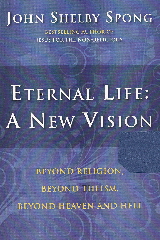
John Shelby Spong's latest book is being released this month.

John Shelby Spong's latest book arrives in bookstores this month.

By Barbara Falconer Newhall

Former Episcopal Bishop of Newark John Shelby Spong says it’s time to ditch the two principle beliefs of Western religion.

The first one, he says, is that God is other, “a supernatural being who can do for me that which I cannot do for myself,” a situation that requires getting and staying on God’s good side.

The second outmoded belief is that human beings are alienated from the sacred and that our alienation requires some kind of atonement — which is another way of saying that we are all guilty as hell. 

On these two premises, says Spong,  have Western believers placed their dearest hopes for eternal life.

And it’s bunk.

Modernity, science, knowledge and reason have demonstrated once and for all that these premises are flawed, Spong argues in his latest book, Eternal Life: A New Vision – Beyond Religion, Beyond Theism, Beyond Heaven and Hell.

To continue to believe in this sort of religion is to be naively, hopelessly and pathetically stuck in denial. To cease to believe, on the other hand, means accepting that the universe – and we ourselves – are meaningless accidents.

Spong profers a third way, however, one that involves being “fully human.” We are not really separated from God, he asserts. Rather “we are part of what God is and we are at one with all that God is.” We are finite, but we share in infinity. We are mortal, but we share in immortality.

Spong, who turned 78 this year, says that “when I die I will rest my case in the ‘being’ of which I am a part . . . I step beyond words at this point into the wonder of a wordless reality.”

I like Spong’s sense that human beings are “at one with all that God is.”  And I can cheerfully recommend this book to readers who don’t accept the idea of a  miraculously parting Red Sea, or a Jesus risen bodily from the dead.

But, for me, questions remain: Is God an other, a person with whom we can enter into a relationship? Or are we part of God, each of us an expression of the Infinite? Or something else entirely?

Unlike Spong, I don’t think I have the answers to these questions. I have no certainty regarding God’s otherness vs. God’s me-ness. I’m not at all sure that traditional, God-as-other religion is delusional. Hey, for all we know, there may be an actual God out there creating and loving the Universe even as we speak — even as we debate the fine points of God’s time-and-space-shattering nature.

As Huston Smith repeats often in his recent autobiography, Tales of Wonder, “We are born in mystery, we live in mystery, and we die in mystery.”

Or, as I am wont to say: God is Big.

Eternal Life: A New Vision, by John Shelby Spong, HarperOne, 2009, hardcover $24.99.

© 2009 Barbara Falconer Newhall

EmailFacebookTwitterStumbleUponPrintFriendlyShare

GodsBigBlog: I’m Off to a Religion Newswriters Conference

By Barbara Falconer Newhall

I’m off to a Religion Newswriters Association conference in Minneapolis — September 10 – 12.

Religion and the Obama administration, religion and immigration and my favorite, the disappearing hymnal, will be among the topics.

For RNA newcomers to my blog, I’ve stickied a bunch of my old GodsBigBlog posts below on this first page.

If you’d rather hear about my Case of the Human Condition, or check out my Book Openers, or join me in The Writing Room, just click on your favorite category on the right side of the page.

I’ll catch up on your comments when I get back!

EmailFacebookTwitterStumbleUponPrintFriendlyShare
<?php if ( function_exists( 'yoast_analytics' ) ) { yoast_analytics(); } ?>