A Case of the Human Condition: Flowers Bursting From the Dirt — How Do They Do It?

Gerbera daisy. I can't decide if this blossom is supposed to be awkward and charming. Or just plain deformed by insects, the stress of transplanting, or life.

Gerbera daisy. I can't decide whether this blossom is supposed to be awkward and charming. Or whether it was deformed by insects, the stress of transplanting, or life on Earth.

They emerge from dirt, mud, manure, wood chips, worms, sow bugs.

They taken in water and sun.

And here they are — with their clean, symetrical lines, dewy textures and colors beyond naming.

How do they do it?

Camelias in winter

The camelias in our Northern California front yard start blooming around Christmas. Does that make them late fall -- or early spring -- bloomers?

Is this a daisy? It was growing early August in Santa Fe, New Mexico. Not a shy flower.

Is this a daisy? Not shy, it announced itself from a flower bed at St. John's College in Santa Fe, New Mexico, in early August.

I planted these gerbera daisies so that I could have them as cut flowers. But then I couldn't bear to cut them.

I planted these gerbera daisies so that I could have them as cut flowers. But then I couldn't bear to cut them. Photos c 2009 B.F. Newhall

EmailFacebookTwitterStumbleUponPrintFriendlyShare

A Case of the Human Condition: A Generation of Preschoolers Trapped in Their Yards

A neighborhood with sidewalks, yards, porches and big front windows.

A neighborhood with sidewalks, open yards, porches -- and big front windows. c 2009 B.F. Newhall

By Barbara Falconer Newhall

The Oakland Tribune

June 10, 1987

“Do you care about sidewalks?” the realtor wanted to know.

My friend Chris, fresh from the Midwest and shopping for a house in the Eastbay, was puzzled by the question.

Doesn’t every street have a sidewalk, after all? Isn’t Main Street, with its shade trees and toy-strewn walkways, as American as apple pie and working motherhood?

The realtor persisted. In California, you have to choose.

Here, you can live in places like Piedmont, East Oakland, Pleasanton, San Leandro, Albany and Moraga – where streets are straightish and houses are arranged in neat, Eastern-style rows.

Or, you can opt for the likes of Sunol, Montclair, Orinda, Lafayette and Kensington – where residents live in rustic, sidewalkess seclusion, on mini-estates tucked behind redwood fences and pyracantha hedges.

In the first type of neighborhood, sidewalks are busy with preschoolers riding tricycles up and down the block, calling playmates out of their houses as they go.

Bay windows provide a clear view of grassy front yards, children at play – and the bay window across the street.

In the second type of neighborhood, you can gather your nude sunbathing deck, your hot tub, your gazebo, your Weber barbecue, your redwood swing set, and your loved ones behind a hedge or fence, safe from the eyes of neighbors, joggers, bicyclists, motorists and the occasional oddball pedestrian.

At our house, we never have to close the draperies on our view. Most of our windows overlook a hillside thick with poison oak.

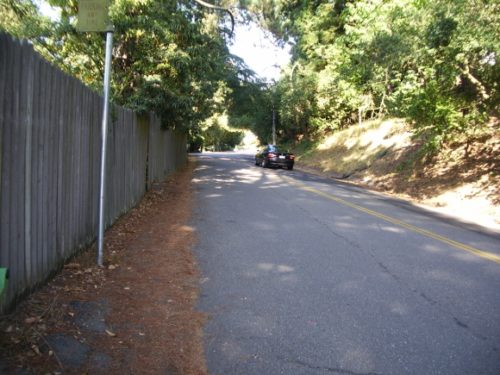
A San Francisco Bay Area neighborhood where fences are permitted and sidewalks omitted.

A residential neighborhood where fences are permitted and sidewalks omitted. There are houses, and maybe even kids, behind that fence and those trees. c 2009 B.F. Newhall

When we first moved here, we liked our privacy. Now, we are not so sure.

Nelson is 6 years old, just Peter’s age and an ideal playmate. He moved in two houses up the street a year ago – but it was four months before we knew he existed.

If our neighbors come out of their houses, it is through the garage door – seatbelted into air-conditioned Volvos with the windows up.

Nelson may live right across the street, but he might as well live in Daly City.

If he and Peter are to play, an appointment must be made by telephone and an adult escort arranged to see one child or the other safely across the minefield that is our trafficky street.

In their book, “The Serious Business of Growing Up,” a group of the University of California at Berkeley researchers who studied the after-school lives of 764 Eastbay children described an Oakland neighborhood that resembles ours.

“You do not see children when you drive (these) hilly streets,” they wrote. “There are no sidewalks. Many houses are set back from the road, their windows turned to catch a view of the San Francisco Bay. There is . . . a feeling of isolation, a sense that residents want to be left alone.”

The children of the neighborhood “interact with few adults other than their parents,” the report continued. They have “few opportunities to do things and go places on their own.”

Go places on their own.

A neighborhood should give its children familiar, safe places to play, Margaret Mead once wrote. But it also should allow them to move out on their own, “to live dangerously part of the time.”

As citizens of the 21st century, our children will need “the confidence and the kind of autonomy that can be translated into a strength to bear the strange, the unknown and the peculiar.”

Country estate neighborhoods do little to invite small children out of their own backyards and into the wider world of people. Yet they continue to be built.

Chip Pierson, an architect for Dahlin Group Architects of San Ramon, said that sidewalks are being omitted in many Eastbay neighborhoods because they make front yards look small.

And, according to one Contra Costa County city planner, “in the places that are most prestigious, no sidewalks are planned because developers don’t feel people will be walking.”

Adults and children old enough to drive may not do much walking.

But how is the 3-year-old or the 8-year-old to get about? If he lives in a secluded, sidewalkless neighborhood, he remains dependent on his adults to get him where he wants – or they want – him to go.

A house behind a hedge -- private or isolated? c 2009 B.F. Newhall

A house behind a hedge -- private or isolated? c 2009 B.F. Newhall

Meanwhile, more and more fences are going up along our street. One of them is six feet high and 50 feet long. It is looking less and less like a rustic country road and more and more like a Los Angeles Freeway.

I’d rather live on Main Street.

© 1987 The Oakland Tribune

Peter was fully ten years old before we allowed him to cross our busy, curving, hilly — sidewalkless – street to “Nelson’s” house by himself. 

Peter’s doing just fine in “the strange, the unknown and the peculiar” 21st century. He went off to college in the Midwest, traveled to India with his friend Praja, criss-crossed Europe on his own, and now lives in Minnesota with its strange and peculiar subzero winters.

As for Nelson, his real name is Leo Moses Kremer and he’s not afraid of the world either — he’s played bass for the alternative rock band Third Eye Blind and now he’s getting ready to open a taqueria in Manhattan; watch this space.

Read more about being Peter’s mom at “How Selective Service Made a Man of My Son.” 

EmailFacebookTwitterStumbleUponPrintFriendlyShare

A Case of the Human Condition: In Your Face Orchids

Orchids

Orchids

There’s nothing I can say about these orchids.

Except that they were growing in Thailand, on a farm, where there were so many feats of blossoming splendor that by tour’s end Jon, Christina and I were wailing, “No! Please! Not another stupendously beautiful orchid! Get me out of here! Take me to the snake ranch!”

Where, of course, the snakes were beautiful too.

© 2009 Barbara Falconer Newhall


. . . more orchids . . .

. . . orchids . . .

. . . and more. Photos c 2009 B.F. Newhall

. . . and more orchids. Photos c 2009 B.F. Newhall

EmailFacebookTwitterStumbleUponPrintFriendlyShare

A Case of the Human Condition: Mad Men Exposes the ’60s Girdle — But How Will She Get It Off in Time?


I loved the strip tease on last Sunday’s Mad Men season premiere. The fitted suit. The cloche hat. The pumps. So 1963.

For those of you who missed the show: A blond stewardess drops her mid-century modest garments to the floor, one by one, until there is nothing left between her, the show’s hero, and their one-night stand – except a girdle.

I want to know — how was she planning to get that thing off?

You don’t think it’s a problem? Then you’ve never experienced a genuine 1963 girdle.

When my daughter was eight years old, I took her aside one day and explained the girdle facts of life to her. Read all about it below:

Don Draper smokes and ponders his existential angst in the Mad Men TV shoow logo.

Mad Man Don Draper smokes and ponders his existential angst.

By Barbara Falconer Newhall

The Oakland Tribune, October 13, 1991 

“What’s a girdle?” Peter wanted to know.

“It’s something you . . . a woman wears to make herself thin,” I told him.

“Why not just get a Tummyciser?” said Peter, rolling his belly muscles.

You could.  You could get the Tummyciser.  You could do the aerobic walking.  You could eat the cottage cheese instead of wearing it on your thighs.  Or, you could spend $26 for a navel-to-knee body shaper – and be thin now.

As I see it, the world our children are inheriting fairly oozes with ways to feel better fast – fast food, fast cars, fast sex.

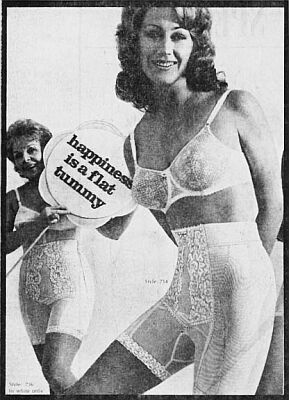
But this season, there is another quick fix on the scene.  Something I thought the women’s movement had banished from the intelligent woman’s underwear drawer decades ago – the girdle.

There it was, a week ago Friday, a department store ad touting the sexiness of shapewear.  Shapewear!  You can’t fool me.  I remember the ’50s.  I know a girdle when I see one.

I dropped Peter off at a friend’s house and took Christina with me to the mall.  Just us girls.  There, we located the Bali tailored brief, the Flexees Subtract and the Vanity Fair Slender Slip, as advertised.

“Do you know what a girdle is?” I asked my daughter as I hung the garments up in our fitting room.  Christina, who was eight years old at the time, wasn’t sure.  Embarrassed, she pointed at my derriere.

Good.  There was still time to warn my daughter off the girdle, in all its anti-woman, anti-health, anti-common sense ridiculousness.  I held up the Bali brief and declared, “No, Christina.  This is a girdle.”

It was an extra large.  I had grabbed the largest Bali on the rack so I could get it on without too many gyrations.  My goal was to make the girdle appear ridiculous in the eyes of my eight-year-old, not myself.

“I’m not going to buy one of these,” I said, pulling on the Bali.  “I’m just going to teach you some history, some girdle history.”

“I already know enough history.”

“If you don’t know history, you are doomed to repeat it,” I retorted, grunting a little with the familiar effort of pulling spandex across flesh.

There is nothing fatter than a woman in the act of putting on a girdle.  A girdle has a way of collecting up flesh as it is pulled upward, pushing it in a trembling mass toward the waist.

The experienced girdle-wearer knows this.  Patiently, she works the garment toward her waist and then, with a yank and a wiggle, she snaps the last bit of girdle over the last bit of fat.  Her body has been tamed.  Spandex rules.

The Bali in place, I glanced at Christina.  “How do I look?”

“It makes you look worse,” she said.  “It’s squashed all the fat onto your legs.  Your legs look way too fat.”

I turned to one side and looked in the mirror, hoping she was wrong.  She wasn’t. “Girdles do that,” was all I could say. “Let’s try the Slender Slip.”

The Slender Slip was a tour de force of modern technology.  It was shaped like a pencil-thin slip, but was made of stretchy, leg-hugging material.  A panel through the crotch and some rubbery stuff inside the lace at the bottom kept it from riding up.

I watched myself in the mirror as I pulled it on.  I realized that there is something fatter than a woman pulling on a girdle.  It is a woman wearing a Slender Slip.  The Slender Slip curves cruelly under the derriere and around the potbelly.  It highlights every lump and curve.  It is merciless.

I took it off before Christina could comment and I reached for the Flexees Subtract.  Designed to slenderize from waistline to shin bones, this was easily the largest expanse of spandex I had ever seen.  I had never worn such an ambitious girdle.

“This is the ne plus ultra of foundation garments,” I said, slipping some French into the history lesson.  Carefully, I gathered up the right leg and slipped my foot through.  “You have to pull these on a little at a time.”

I lectured and pulled and lectured and pulled, hoping Christina was noticing what a pain in the derriere a girdle can be.

A pain in the derriere and a pain in the belly.  My girdle memories were coming back to me now.  Some I shared with Christina. Others I saved for a later date.

If a woman wears a tight girdle for more than an hour or two, for example, she is likely to experience stomach cramps, especially if there is a meal involved.

Or, if she sits in her girdle for very long, she can get girdle burn.  The girdle stretches as she sits, causing the tiny holes in the spandex to open up and capture tiny pieces of her skin.  When she stand, the spandex holes close up and pinch her unsuspecting flesh.

And, too, there is the chastity-belt effect.  A girdle is not easy to put on.  The prudent woman thinks twice before taking one off.

At last, the navel-to-knee girdle was in place and I looked – terrific.  My lower half was at least two sizes smaller.

“It looks good on the bottom,” said Christina, “but you look weird on top, like raw chicken meat.  I like it better when you be yourself.”

End of history lesson.

Reprinted by permission of The Oakland Tribune

Christina Update, February 5, 2012. Did my
daughter learn that girdle lesson that I sweated and strained over twenty years
ago? Did the lesson stick? I called her up to ask.

Yes, Christina said. She remembers the girdle lesson. And, yes,
she wears a girdle once in a while. But it’s not a girdle. It’s not a Slender
Slip. And it’s not a Flexees Subtract. It’s a Spanx. And the difference between my
girdle-wearing days and Christina’s  is,
you don’t wear a girdle to impress a guy these days. “You wear them
because you’re a strong, powerful woman and you want to look really fabulous –
for yourself.”

Back to the Mad Men episode with Don Draper in a hotel room with a frantic-for-sex stewardess: Now you know why the script required the fire alarm to go off when it did. The Mad Men writers had no idea how to get that girdle off that stewardess without turning hot sex into farce.

Hint: If she knew she was going to do a strip tease, the stewardess would have excused herself to the bathroom, removed the girdle, stuffed it into her purse, and returned to her paramour — fully dressed but girdleless.

And, no, I’m not going to tell you how I know this.

If you enjoyed this post, check out My Awesome Zumba Body.

EmailFacebookTwitterStumbleUponPrintFriendlyShare

A Case of the Human Condition: Why He Never Called Me Back . . .

why-he-didnt-call-you back-rachel-greenwald

By Barbara Falconer Newhall

The book’s cover was fuchsia, its title blunt:  Why He Didn’t Call You Back.

Wow. Just what I needed. Not now. But back in the 60′s and 70′s when I was young and single and hopeful in New York and San Francisco . . . when I was doing a lot of dating and a lot of wondering why so many guys would take me out once or twice — then disappear without explanation. Gone. Evaporated. Poof. 

And now, years later, the mysterious rejections still rankled. Why hadn’t those guys (and there were dozens of them) ever called me back? I still wanted to know.

The book was sitting on a shelf  in the Chicago Midway airport bookstore. I had some time before my flight left for Oakland. I picked it up and started to read.

The author, Rachel Greenwald, explained that as a professional dating coach she was puzzled by the large numbers of attractive women among her clientele who weren’t getting called back after the first date. To find out why, she located some actual men,  hundreds of them, and talked to them. She asked each one why he hadn’t called various women back after the first date. Greenwald then analyzed their responses and compiled the rejectees into categories.

I couldn’t stop reading, but it was time to catch my flight, so I plunked down $24 and took Why He Didn’t Call You Back with me to the gate. I wasn’t buying this book for my own improvement, I told myself. I was buying it for my daughter, who was single and would be turning 26 soon.

Somewhere over Iowa, still wondering why all those guys had never called back, I cracked open Greenwald’s book, studied her categories and took her little quizzes. Which kind of loser had I been, really, as a young something all those years ago? Greenwald outlined more than a dozen possibilities, some of which maybe applied to me:

The Blahs. A major turn-off, Greenwald states, is the Blah woman, the one who doesn’t say or do much on the date. Definitely not my problem, I was pretty sure. I was a big talker as a young woman, a sharp dresser, a good dancer, and a flirt.

The Psychobabbler. Another big turn-off, according to Greenwald. But no, that wouldn’t be me either.

The Wino? No. Not that I remember anyway.

The Ex Factor. This is the woman who talks too much about her ex. I never got far enough to have an ex.

The young and single me -- smoking! c 2009 B.F. Newhall

The young and single me -- smoking! c 2009 B.F. Newhall

The Boss Lady. The career woman who takes charge, one-ups her date in conversation, expresses opinions with finality, and generally acts like this is a competitive job interview rather than dinner with a new and interesting friend. Hmmm. That could be me.

Dicing women up into types objectifies them, of course. But the idea that a woman, nervous on a first date, can unwittingly fall back onto stereotypical behavior is a useful one. And Greenwald has lots of suggestions for tweaking one’s conduct to avoid giving misleading first impressions.

The woman who is a jock, for example, can bring out her feminine side by wearing a skirt or jewelry. The talker might do some heavy listening. And the woman who’s sure she wants to marry a Jew or a Catholic or a virgin or a New Englander would do well to keep a lid on her opinions long enough to find out whether that divorced Unitarian from Kansas City might actually be Mr. Right.

Greenwald’s best advice, however, had nothing to do with types, and it came as a surprise to me. The quality most appreciated by the men Greenwald interviewed was simple human kindness. Men notice and appreciate a woman who shows consideration  for the waiter, the cabbie, the ticket taker, her date.

Some women have found Greenwald’s book irksome. That is, they have found the men in her book irksome. They read the men’s criticisms of their first dates as further evidence that guys are basically arrogant bastards and not to be trusted.

Which makes me wonder whether a lot of single women (my young self included) aren’t too inclined to find fault with the male of the species and behave accordingly — all too ready to fire the first shot.

I read this book to its end, wishing somebody had given it to me when I was young and fearful. My daughter got it for her birthday.

© 2009 Barbara Falconer Newhall

Why He Didn’t Call You Back, by Rachel Greenwald, Crown Publishers, 2009, $24 hardcover.

EmailFacebookTwitterStumbleUponPrintFriendlyShare
<?php if ( function_exists( 'yoast_analytics' ) ) { yoast_analytics(); } ?>