A Case of the Human Condition: Feminine, Feminist Pink

By Barbara Falconer Newhall

The Oakland Tribune, October 9, 1988

When this column first ran in the Trib, I was sure that spike heels and inch-long fingernails would be seriously passe by the turn of the millenium. But here it is, 2009, and fingernails and spike heels are as long and lethal as ever.  Pink, on the other hand — in the case of Christina anyway — has gone the way of  frothy tutus and My Little Pony.  “I look better in purple,” she says now, at age twenty-five.

Christina likes pink. Christina is five years old. Given a choice, Christina will take the pink balloon, the pink panties, the pink baseball bat.

Christina: Palette preferences  c 1988 B.F. Newhall

Christina: Palette preferences c 1988 B.F. Newhall

And Christina likes her pink pink. Cerise, rose, fuchsia – none of the variations on the color pink will do it for her. She wants the real thing, powder puff pink, little girl pink.

“Peter’s favorite color is orange,” she can tell you. “Mommy’s favorite color is red.” But red does not mean to me, nor orange to Peter, what pink means to Christina.

Christina’s choice of favorite colors is for her a creed, a confession of faith. Pink announces who she is.

And whenever she makes her confession, to family or strangers, I am tempted to apologize for her corny taste, her vulnerable little self.

I resolve to discuss with her the expressive possibilities of mauve, salmon, lavender.

“Toughen up, kid,” I want to say. “There is no need to bare your soul to the world every time you put on socks. Consider the southwest colors – sage brush, bone, mustard. How about something you can wear with a brief case – maize, teal blue, grayed burgundy?”

For some of us, pink is the ultimate expression of the yielding, feminine spirit. For others, frizzed hair, high heeled shoes, nylon stockings with seams, or long, jewelry box fingernails say it better.

You would think that spike heels, impossible as they are for engaging  in any of life’s truly worthwhile pursuits – shopping, dancing, disbudding the camellias – would have, by the late 20th century, gone the way of the bustle and the bound foot. Spikes pinch the toes, throw the pelvis out of whack and put extraordinary stress on the floors of airliners.

The same goes for the inch-long fingernail. Now that executive, as well as clerical, women are keyboarding, one would think that nails would be kept stylishly short.

But no. Two decades into the current feminist movement, spikes and fingernails are back with a vengeance, wobblier and glitzier, respectively, than ever, and – to my Midwestern eye – looking more than ever like weapons and less than ever like an invitation to dance or what have you.

Widows no longer immolate themselves on their husband’s funeral pyres in India. And female circumcision is regarded as barbaric by most humans.

But here in the West, women continue to handicap themselves with stiletto heels and butter knife fingernails. Some persist in dressing themselves in pastels as giving as margarine on an Indian summer afternoon.

What’s more, even as certain progressive Eastbay mothers are declining to have their newborn boys circumcised, others are arranging for their newborn daughters to get their ears pierced.

But why?

“I feel confident enough now about my feminism to wear pink,” says Leah. “I used to think I couldn’t wear it without copping out.”

The same could be said for FloJo. With thighs as massive as Doric columns, and a 100-meter record less than a second slower than that of the fastest man on earth, FloJo can afford to acknowledge her femininity with Cleopatra fingernails.

But why does she bother?

We can outline a legal brief, drive a spaceship and run a marathon, but here we are, two hours before lift-off, plucking our eyebrows.

What gives?

I have my theories. But be forewarned, they tend to assume the innate superiority of women.

Let’s face it, all men are born with a monumental, if rarely noted, defect: they do not carry and give birth to their babies.

They have to find a woman they can trust to do that. And trust is essential. If he can’t trust her, how does he know the baby is his?

We women feel sorry for those men. To help them out, we wear pink and hobble our hands and feet with jewelry and tight shoes. By being pretty, we say, in so many words, I’m all yours and, don’t worry, so is the baby.

Also, right-brained as we are, we women are supremely sensitive to our surroundings. We decorate everything in sight – Levelors for the windows, antique roses for the garden path, Ficus benjaminas for the board room.

As soon as we have finished rearranging our surroundings, we start in on ourselves. Hair, bust, toenails, lips. Nothing is overlooked.

In short, we are artists. And just because we cannot take time out from our responsibilities as mothers, homemakers and, now, breadwinners to create a “Last Supper” or two, doesn’t mean we can’t find time to make sure the lipstick and the nail polish are the same color – pink.

© 1988 The Oakland Tribune

EmailFacebookTwitterStumbleUponPrintFriendlyShare

A Case of the Human Condition: When Your Six-Year-Old Wants to Talk Money

By Barbara Falconer Newhall

The Oakland Tribune, November 15, 1987

Peter likes money.

He wants an allowance.

The subject came up at the breakfast table.

Jon and I debated. Fifty cents a week? 75 cents?

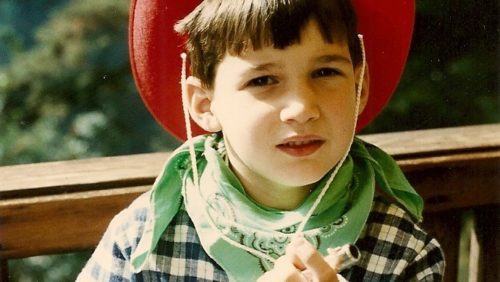
Peter: Halloween cowboy  c 1987 B.F. Newhall

Peter: Halloween cowboy c 1987 B.F. Newhall

“Let’s not talk in cents,” said Peter, who is 6 1/2, pushing 7. “Let’s talk in dollars.”

He wanted $2.

Nonplussed, I changed the subject.

Spending his allowance on candy would not be allowed, I said. “No candy, no weapons, no caps for the cap pistol.”

Jon demurred. “It’s Peter’s money.”

“It’s my money,” said Peter.

Not yet it wasn’t.

We were stalemated. The subject was dropped.

Peter likes money because he likes things. Money can buy him things.

He comes by the tendency honestly.

His paternal grandfather likes things. Victorian Furniture. ’57 Chryslers. Coins.

Peter likes Battle Beast vehicles. Walkie talkies. Rainbow, his stuffed puppy. He-Man swords. Cowboy pistols. Space stations. His blankie.

His things help him to think.

If he is feeling cuddly, he wraps the blankie around Rainbow. Lonesome, he calls Mommy on the Walkie Talkie. Powerful – or powerless – he pits a Battle Beast against the enemy and defeats him soundly.

Peter is loyal to his things.

Every stuffed giraffe, battered firefighter’s hat, nursery school glue project and legless Superman holds an eternal and immutable place in Peter’s heart.

But that does not mean there is no space in Peter’s heart or in Peter’s bedroom for something new.

At the toy store, he spotted a Battle Beast vehicle he had never seen.

“Mommy, can I have it?”

“It’s expensive. It’s $12.83.”

“I want it.”

“Well, you could earn it. You could learn your math facts. I’ll give you a dime for each time you practice a set.”

“You will? Rad!”

“$12.83 is a lot of money. It will take a lot of work.”

Peter fondled the shiny package.

“Mommy, I want to work,” he said firmly.

It cost me $12.83 and 4 ½ hours of my own time, but three days later, Peter knew his addition facts, right down to six plus seven and eight plus nine.

“Three plus four. Three plus four,” said Peter, slapping his forehead. “I’ve got to think faster. Oh, yeh. Seven!”

Another dime clinked into Peter’s stash.

“Wait, mommy, let’s count how much dollars I have.”

Again and again, Peter counted his money.

He learned he could make a dollar with 10 dimes or four quarters. He counted his coins by twos, by fives, by 10s.

I was stunned. I did not know that Peter could learn so much so fast. I didn’t know that he was so intensely interested in money.

Most of all, I was surprised that I could pander so unconscionably to my son’s greed.

When Peter was a toddler and still soiling his pants, I tried everything.

I let him go barebottomed. I followed him around with the potty. I praised. I scolded. I tried patience. I tried exasperation. Nothing worked.

Finally, I tried M&M’s – one for Peter, one for Christina – for every successful trip to the potty.

It worked.

It worked, not because Peter is a profane, banal kid who responds only to bribes. It worked because I gave Peter a choice. He could use the potty and get an M&M. Or he could use his underpants and not get an M&M.

For the first time in his life Peter – not Mom – was in charge of his bathroom functions.

Stephanie’s mother uses raisins and Cheerios.

To get Stephanie to practice her reading last year, she put a raisin or a Cheerio on each word in the word list. Stephanie read and ate, read and ate, read and ate.

“They need a reward,” explains my sister-in-law, Alice, a school counselor and my mentor in these things.

“I wouldn’t work if I didn’t get paid for it. Why should they?”

At least one other mother in our neighborhood has come to understand the value of money.

“I’m going to sell my candy to my mother,” Sterling informed Peter on Halloween night. “Then I’m going to buy a toy.”

“That’s right,” said Claudia, as she served up a Halloween supper of low-cal turkey lasagna. “Then I’m going to throw it all away.”

Two nights later, Jon and Peter saw Sterling and his mother at Safeway.

Sterling was still in possession of his candy.

“I want $30 for it,” said Sterling.

“And I won’t pay more than $5,” said Claudia.

© 1987 The Oakland Tribune

Peter is 28 years old now. He’s paid off his student loans and his car payments, he doesn’t mind taking the red eye, and if there’s a 401k in the picture he’s maxed it out.

Another story from Peter’s childhood at “I Can’t Say No to Toys.” 

EmailFacebookTwitterStumbleUponPrintFriendlyShare

Writing Room: The Punch Line Always Goes Last

By Barbara Falconer Newhall

Everyone knows that the punch line goes at the end of a joke, not the beginning. A mystery writer knows to set the story up and get all the necessary events and clues in place before revealing that the pizza delivery guy did it.

The same is true of a paragraph and a sentence. When writing a paragraph or sentence, give your readers the information they need in the order they need it. For example, if you have a headache and you are asking your housemate to please get you an aspirin from the bathroom, you don’t say, “It’s on the bottom shelf, in the cupboard next to the sink, in the bathroom, upstairs.”

You would give your housemate – and your reader – the information one chronological or logical step at a time. You’d say, “The aspirin is in the upstairs bathroom, in the cupboard next to the sink, on the bottom shelf.” Wouldn’t you?

Author Lindsey Crittenden

Author Lindsey Crittenden

Sentences can benefit from the same kind of orderliness. Let them flow logically. One of the two sentences below is lifted from Lindsey Crittenden’s  memoir, The Water Will Hold You: A Skeptic Learns to Pray (Harmony Books). The other one is not.

Which one feels clean and logical? Which one sends you scrambling to read the sentence all over again, now that you’ve learned what the point is?

“How do you think that makes me feel?” she wailed when I admitted that I’d thought of suicide.

When I admitted that I’d thought of suicide, she wailed. “How do you think that makes me feel?”

The second sentence is from Crittenden. The first sentence is my doing. (And my apologies to Lindsey for changing the tense in both sentences, just a wee bit.) Notice how the quotation, when it’s placed at the beginning of the sentence has no meaning until the reader finishes the sentence. This sentence requires the reader to go back and forth, rereading and doing way too much work, work that is your job as the writer. You want it to be your job, because if a reader has to stop to figure out the meaning of a sentence, he or she is likely to quit reading. I call this writing error “putting the cart before the horse.”

I’d love it if you would share any cart-before-the-horse examples you come across in your reading, especially the funny ones. We can all learn from them.

All this brings to mind some wonderful advice from the novelist and writing teacher John Gardner. I don’t have the exact quote at my fingertips. It goes something like this: Good writing is a dream from which the reader does not wake. Clumsy sentences and paragraphs (like the ones I wrote above) cause readers to wake up from the dream – and close the book we’ve worked so hard to write.

Gardner says it better than that. Who can help me find the exact quote?

© 2009 Barbara Falconer Newhall

EmailFacebookTwitterStumbleUponPrintFriendlyShare

A Case of the Human Condition: Beauty — What to Do About It

In Bangkok, Thailand, a handmade hatBy Barbara Falconer Newhall 

I confess, I’m not very good at being in the moment, even if — especially if – the moment is a nice one. If I’m having a good time, my mind tends to lurch into the future to the day when this loveliness will be no more. My thoughts sink into nostalgia and sadness at the knowledge that everything ends, especially, it seems,  the really good stuff.

Be alive to the moment. Be present to the holiness of this place. Buddhism recommends this. Modern psychology encourages it. Christianity and Judaism know about it. (“Be still and know that I am God.”) In my opinion, it’s what Edna St. Vincent Millay was thinking when she wrote “Renascence:”

God, I can push the grass apart, And lay my finger on Thy heart!

The physical therapist reiterates it as she contemplates my overstressed and overdeveloped trapesezius  muscles. I gotta do it, she tells me. Relax those muscles. Let go of that anxiety. Be in the moment. Be here now.

But — and here comes the big but – when I encounter something beautiful, I can’t seem to The frescoed ceiling of the Duomo, Florencejust sit there and be with it. For reasons I don’t understand (yet) I am greedy and grasping when it comes to beauty.

An exquisitely foggy day in the canyon behind my house? A star magnolia blossom battered by yesterday’s rain? Across the Bay in Marin county, a footpath cutting into the steep western flank of Mount Tamalpais? In Florence, the Last Judgement frescoed onto the interior of the Duomo? On a scorching, sun-pierced day in Bangkok, a Thai peddler offering me a hat?

In each instance, I feel I must do something about this wondrous event. Make it last. Make it mine. And so, like a lot of people, I get out the camera and take a picture.

What you see posted here, therefore, is the work of a greedy woman, a person who can’t get enough of that wonderful stuff, beauty. Right now, however, I’m not regretting my greed. As I upload these photos, one at a time, I notice myself lingering over them, studying them, savoring them. I am lost in the moment.

Beauty drove Tess Gadwa  to larceny on the way to church yesterday. A Greenfield, Massachusetts, blogger, Tess says she found a painted Easter egg  lying on the ground, forgotten and forlorn.  Instead of putting the egg back where she found it or handing it off to a deserving child,  Tess boldface kept the thing. The Egg Thief’s reasoning: “Beauty is worth stealing when you find it.”

Text and photos © 2009 Barbara Falconer Newhallcanyon-trees-fog-beautyrain-battered-magnolia-beautyWalking Mt. Tam in spring

EmailFacebookTwitterStumbleUponPrintFriendlyShare

GodsBigBlog: Native American Tori Isner — Want to Find Holy? Go Look at a Rock

By Barbara Falconer Newhall

An Army vet and a grandmother, Tori Isner is an adopted Lakota Sioux who traces her roots to the Eastern Band of Cherokee of North Carolina. She currently lives in Texas. 

Here’s what Tori told me about how and where she encounters Spirit:

“Living in the city, you forget how many stars there are. You forget how bright the night can be when the moon is full. It’s a family thing, the spiritual world. It’s a connectedness to everything around you, Mother Earth, Grandmother Moon, Grandfather Sun.

“Everything is part of the family. The buffalo is your brother. The standing people are the trees. They’ve been here a lot longer than you have, they can teach you.

Joshua Tree National Monument c 2009 B.F. Newhall

Joshua Tree National Monument c 2009 B.F. Newhall

“Go stand next to a big rock, see how big you really are. Go look at the ocean. That’s Creator, that’s beauty.

“With us, it’s Creator who created the food, created the buffalo, created the rocks, the grass, Mother Earth and everything we have. Creator did that. And we’re honored just to walk on it, just to live, just to be.

“Creator is in everything we do. And in everything we do, we give thanks. If I eat a meal, I make a Spirit plate. I take a little bit of food from everything that I have on my plate, and a little bit of tobacco, and put it out on the back porch.

“That’s giving thanks to Spirit for the food that I have and for the abundance that I have. It’s just a small thing I can do for the gifts that I get.

“You acknowledge that everything comes from Creator and that none of this is truly yours. You’re just borrowing it.

“Your body is a vehicle. Like the trees, that’s their form. And the plants, that’s their form. And the buffalo, and the horses and everything, those are their forms. These are all vehicles to carry the Spirit around.

“Everything that I am is from Creator. The greatest gift I can give is myself back to the one that created me. I am the only one that can authorize the offering of myself. No one else can. And I do that willingly.”

© 2009 Barbara Falconer Newhall

EmailFacebookTwitterStumbleUponPrintFriendlyShare
<?php if ( function_exists( 'yoast_analytics' ) ) { yoast_analytics(); } ?>